
At any point in your cloud security journey, you should consider practical architectures, frameworks, and benchmarks that will benefit your current and future infrastructure. These tools will provide guidance directly from those who have pioneered similar solutions. Working with existing designs will speed up your efforts and provide your organization with confidence that it is following industry security standards.
Architecture vs. Framework
What is the difference between an architecture and a framework? Commonly, a framework encompasses several architectures. However, the opposite can also be true, such as in the Zero Trust Architecture (ZTA). So, the frameworks mentioned below will contain several architectures such as SIEM, EDR, etc.
Architectures and Framework Examples
All cloud vendors provide best practices architecture guides and frameworks.
For example, Microsoft has:
- The Cloud Adoption Framework (CAF) – for guidance on migrating to the cloud.
- The Well Architected Framework (WAF) – for details on specific workloads.
- The Microsoft Cloud Reference Architecture (MCRA) - a collection of PowerPoint slides presenting a wide range of security architectures.
- The Zero Trust Maturity Model is described as an architecture containing several frameworks.
Security Benchmarks
In addition to frameworks, there are security benchmarks that can be used as controls for ensuring cloud resources are behaving according to some measure of security standards.
An example of this is the Microsoft Cloud Security Benchmark (MCSB). We can think of the MCSB like NIST or CIS compliance controls, however, it includes secure scores, which assist in prioritizing the security improvement processes.
Combining Benchmarks, Controls and Architectures
Connecting benchmarks like MCSB and controls like NIST along with actual security solutions can help bridge the gap between auditors and security architects. An effective delivery solution can be planned and prioritized by understanding the associations between these topics.
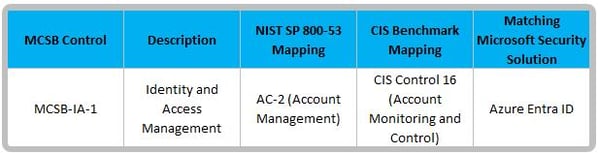
Table 1: Example mapping between MCSB, NIST and a Microsoft Security Solutions
Use Cases
This brings up two questions. Who should use this, and where should it be implemented? It’s typically the cybersecurity architect’s responsibility to understand these topics and to communicate relevant subjects to the required teams, such as the auditors and security operations.
Here’s an example of a use case and how it maps to the architectures, etc.
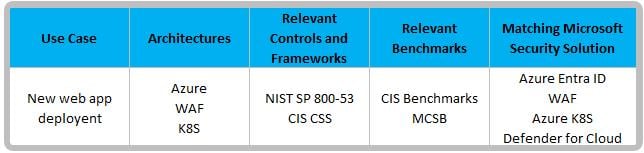
Table 2: Example mapping of an actual use case to the relative architectures, etc.
Summary
Always think in terms of a well-structured architecture when constructing enterprise cloud solutions. Use security benchmarks as controls to keep track of best practices in your security architecture. Understand the relationship between frameworks, architecture, benchmarks, and controls.
References:
- Azure Architecture Center
- Google Cloud Architecture Framework
- AWS Well Architected Framework
- Microsoft Architecture Use Case Examples on GitHub
- CIS Critical Security Controls
- CIS Benchmarks
About This Blog Series
Follow the full series here: Building Defenses with Modern Security Solutions.
This series discusses a list of key cybersecurity defense topics. The full collection of posts and labs can be used as an educational tool for implementing cybersecurity defenses.
Labs
For quick walkthrough labs on the topics in this blog series, check out the story of “ZPM Incorporated” and their steps to implementing all the solutions discussed here.
Compliance
All topics mentioned in this series have been mapped to several compliance controls here.


