

Organizations often lose precious hours and sometimes millions of dollars because they lack a well-defined and tested incident response plan. In many cases, response roles are loosely defined and disconnected from key stakeholders, including digital forensics teams, breach counsel, and cyber insurance providers. Even large organizations fall into this trap, resulting in delayed containment, inefficient recovery, and prolonged business interruption.
After handling thousands of incidents, we have identified four core mistakes that disproportionately increase impact, along with corrective recommendations that will help optimize your incident response plan and resilience capabilities.
1. Lacking Pre-Negotiated Contracts with Breach Counsel and Incident Response (IR) Vendors
Lacking pre-negotiated terms with breach counsel and IR vendors is one of the biggest mistakes an organization can make when facing an incident, but luckily, it’s one of the easier ones to address.
Without a pre-negotiated agreement with an experienced digital forensics and incident response vendor and external counsel, organizations are forced to negotiate terms during a crisis, which can often delay any response action by hours or days. During an active incident, time should be spent containing the threat, not negotiating terms and conditions, debating redlines, or waiting for legal teams to sign a master service agreement.
A few years ago, most vendors would gladly negotiate zero-cost service agreements, but that’s not as common today. Even when available, those agreements would carry a less-than-favorable response time as the vendor prioritizes paying customers in the event of a mass-scale incident. Use this opportunity to negotiate an incident response retainer and secure adequate response time as part of the agreement.
2. Allowing Immediate Response Actions That May Destroy Evidence
We often see well-intentioned but misinformed staff make forensics harder by signaling to the attacker that they have been spotted, causing a cascade of negative actions.
What would appear to be routine and sensible responses for most IT situations, such as shutting down systems, rebooting, not preserving logs, or restoring affected end-user workstations and servers from backups, can irreversibly alter digital evidence. In fact, these actions wipe volatile RAM, which often contains active malware processes, decryption keys, and attacker session data that would otherwise be recoverable.
My colleague, Jamie Mamroe, has a great short video covering this topic, but a few common mistakes include:
- Immediate hard shutdown of compromised systems. While the instinct to "pull the plug" is understandable, this wipes volatile memory (RAM), which often contains active malware processes, decryption keys, and attacker session data that would otherwise be recoverable.
- Reimaging or restoring endpoints from backup before imaging the original drive. This eliminates the forensic baseline our investigators need to trace the attacker's path through the environment.
- Clearing event logs to "clean up" a system or patching the exploited vulnerability before it's been documented. Either action can obscure the initial access vector and make root cause analysis nearly impossible.
Sometimes, these actions may also alert the attacker if they’re still active within your environment, allowing them time to create additional persistence mechanisms and dig themselves deeper.
These actions may also cause bigger legal hurdles. That’s the next mistake we’ll address.
The best way to avoid this mistake is to have an incident response plan that’s frequently practiced in tabletop exercises. These exercises help delineate roles and responsibilities, along with timelines, so that actions such as “pulling the plug” are only done at the right time, by someone with the correct expertise.
3. Missing Litigation-Aware Workflows
Treating cyber incidents as legal matters at the outset reduces the overall impact of the incident, but we still see organizations delay or defer counsel engagement (against our recommendations). This leads to several issues, especially given the record rate of data breach class action litigation.
Common gaps include:
- Failing to establish attorney-client privilege early. Without counsel at the outset of IR, investigation findings and internal communications may not be protected, making them discoverable in future litigation or regulatory proceedings.
- Weak chain of custody documentation. Evidence that isn't collected, labeled, and tracked according to defensible standards can be challenged or dismissed entirely, undermining both legal proceedings and insurance claims.
- No defined escalation path for legally sensitive findings. When responders lack clear guidance on when to pause, escalate to counsel, or preserve specific artifacts, critical decisions get made ad hoc, often in ways that complicate the legal picture later.
Again, the key to avoiding this mistake is not dissimilar to the first two mistakes – having pre-negotiated contracts with counsel and with IR firms that can fully respond under litigation-aware workflows, and testing those workflows in tabletop exercises.
4. Failing to Align Incident Response with Cyber Insurance
While organizations may choose not to file a claim, most policies require the insurer to be notified of an incident. Whether filing a claim or not, adhering to the notification window stipulated in the policy requires at least a few initial response steps to be taken, and without a reliable IR investigator, this can cause issues with claim coverage or policy renewal.
Common misalignments include:
- Using an IR vendor not recognized by their insurer. Many policies require pre-approved vendors, and bringing in an unrecognized firm can trigger claim delays, partial reimbursement, or denial entirely.
- Failing to notify the insurer within the required timeframe. Most cyber policies have strict notification windows, and it’s imperative to notify the insurer within the required timeframe. Without a workflow that includes the insurer as a defined stakeholder, organizations risk voiding coverage through procedural noncompliance.
- Mismatched scope between the retainer and the policy. If the services covered by your IR provider don't map cleanly to what your insurer will reimburse, organizations can find themselves absorbing significant out-of-pocket costs.
This mistake is not easy to address without extensive relationships in the cyber insurance ecosystem. With decades of IR experience, we’re proud of the relationships we’ve built to get LevelBlue on 50+ cyber insurance panels, and how we can help minimize delays or claim issues by following adequate response steps.
The “Goldilocks” Response: Not Too Slow, Not Too Fast — Just Right
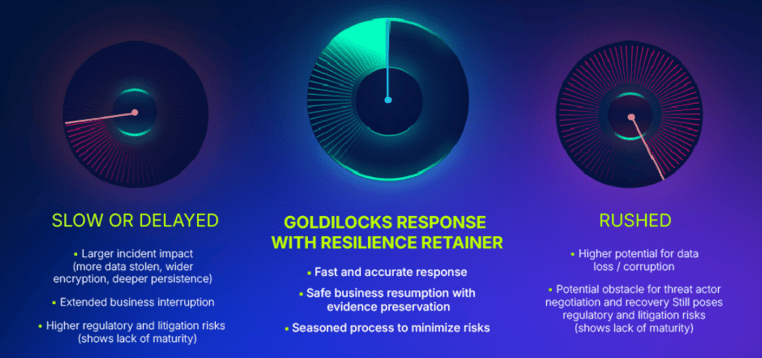
Effective incident response isn't just about speed or thoroughness. It's about calibration. A response that moves too slowly allows attackers more time to steal data, expand encryption, and deepen persistence, compounding both operational and legal damage.
A response that moves too fast, without proper evidence, preservation, or insurer coordination, can create data loss, obstruct threat actor negotiation, and leave the organization exposed to regulatory and litigation risk. Both extremes signal the same thing to regulators and courts: a lack of maturity.
The LevelBlue Resilience Retainer is built to deliver what we call the Goldilocks Response, fast and accurate, but never reckless. By combining pre-approved insurance panel status, litigation-aware workflows, and seasoned IR professionals who know how to preserve evidence while containing the threat, LevelBlue ensures organizations can resume business safely without sacrificing the forensic and legal record they'll need later.
In a landscape where the cost of getting it wrong compounds on every front, having a retainer that gets it right isn't a luxury. It's the strategy.
Gartner continues to recognize us for our digital forensics and incident response capabilities. We’d be happy to customize a retainer that fits your needs and strengthens your overall cyber resilience.


