
Overview
The "ClickFix" threat landscape has undergone a significant architectural shift, transitioning from legacy Windows-based execution to sophisticated macOS-targeted campaigns. These operations prioritize social engineering over software vulnerability exploitation, systematically leveraging established user behaviors and professional workflows. By presenting deceptive "fixes," "verifications," or installation prompts, adversaries induce users to manually execute malicious scripts via native utilities such as the Terminal or Script Editor. This methodology effectively bypasses macOS Gatekeeper protections, facilitating the direct delivery of high-impact infostealers, including AMOS (Atomic Stealer), Cuckoo Stealer, and SHub Stealer, into the target environment.
Propagation Dynamics and Exploitation Vectors
The rapid proliferation of ClickFix on macOS is attributed to its seamless integration into standard developer and administrative workflows. Adversaries utilize a multi-vector approach to achieve initial access:
-
Workflow Conditionality Exploitation: Users, particularly within technical cohorts, are conditioned to execute curl commands for software management (e.g., Homebrew). Attackers exploit this trust by providing malicious command strings that mimic legitimate installation procedures.
-
Typosquatting and Infrastructure Compromise: Campaigns leverage typosquatted domains (e.g., homabrews[.]org) and the exploitation of legitimate web infrastructure. Notably, CVE-2026-26980 (Ghost CMS SQL Injection) was utilized to inject loaders into over 700 diverse domains.
-
Deceptive Troubleshooting Resources: Adversaries generate high-fidelity fake technical articles on platforms like Medium or Craft, directing victims toward "problem-solving" Terminal commands that facilitate malware execution.
Threat Actor Profiling and Variability
Analysis indicates ClickFix is not a monolithic operation but involves multiple competing threat groups deploying a diverse array of macOS malware families:
-
Payload Diversification: Identified payloads include Atomic Stealer (AMOS), Cuckoo Stealer, Macsync, and SHub Stealer, demonstrating a broad capability to adapt to defensive measures.
-
Strategic Asset Targeting: Exfiltration efforts focus on high-value data, including browser credentials (Chromium/Firefox), macOS Keychains, Apple Notes, messaging session tokens (Telegram/Discord), and extensive cryptocurrency wallet databases (Ledger, Trezor, Exodus).
-
Evasion and Obfuscation: Code obfuscation, dynamic C2 rotation, and locale-based filtering (avoiding CIS countries) are consistently employed to maximize operational longevity.
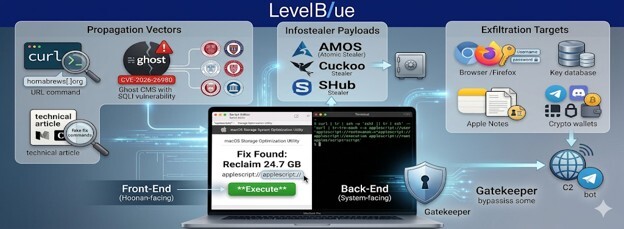
Figure 1. macOS ClickFix attack chain.
Execution Breakdown: Front-End vs. Back-End
Effective detection requires a comprehensive understanding of the dichotomy between the victim-facing social engineering lure and the underlying technical execution chain.
User-Facing Interaction (Front-End)
Victims are directed to high-fidelity, deceptive web interfaces that simulate legitimate services. Common lures include:
-
Scenario A: Deceptive CAPTCHA/Verification: Users are instructed to execute Terminal commands to "verify identity," leveraging native shortcuts like Cmd + Space.
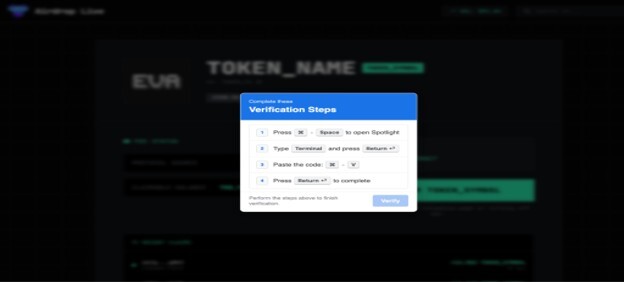
Figure 2. Fake verification steps to execute Terminal commands.
-
Scenario B: Optimization Lures: Fake "Clear Storage" guides prompt the execution of scripts. Newer variants utilize the applescript:// URL scheme to invoke the macOS Script Editor, further obfuscating the malicious intent.
Subsequent stages often involve a native-looking password prompt to facilitate credential harvesting under the guise of installation continuity.

Figure 3. Fake ‘clear storage’ guides are used to execute malicious scripts in a victim’s machine.

Figure 4. ClickFix variant that uses the applescript:// URL scheme to invoke the macOS Script Editor.
This HTML code illustrates the front-end deception of a macOS ClickFix campaign designed to trick users into executing malware. Structurally, it uses web elements to visually mimic a native macOS window, complete with a forged "Script Editor" title bar.
Within this container, line 13 displays an obfuscated curl command that uses the native tr utility to dynamically decode a hidden URL, piping the payload directly into zsh for memory-resident execution to avoid disk detection. Concurrently, line 15 implements a single-click vector using the native Apple URL scheme (applescript://) to force the browser to launch the host's Script Editor.
This URL-encoded hyperlink runs a dual-track routine: it generates a deceptive pop-up claiming to perform a "macOS Storage Optimization" task to reclaim 24.7 GB of space, while silently executing the curl command in the background to deliver an infostealer, bypassing Gatekeeper via user-coerced interaction.
Internal Technical Sequence (Back-End)
While the user interacts with the lure, the following technical chain is initiated:
- Memory-Resident Execution: Initial commands leverage curl to fetch obfuscated payloads, which are piped directly into shell interpreters (bash/zsh), minimizing the disk footprint.
- Credential Harvesting Mechanism: Malware utilizes dscl . -authonly to validate stolen system passwords locally, evading standard authentication logging.
- Gatekeeper Neutralization: Secondary payloads are stripped of quarantine attributes via xattr -d, effectively bypassing macOS security warnings.
- Data Exfiltration: Sensitive assets are staged in temporary directories (e.g., /tmp/shub_), compressed, and exfiltrated via encrypted HTTPS channels.
- Persistence Establishment: Long-term access is secured via LaunchAgents and .plist files, often masquerading as legitimate system or software updaters.
- Targeted Evasion of macOS 26.4 Security Enhancements: The tactical shift by adversaries from traditional Terminal-based execution to utilizing the macOS Script Editor (via the applescript:// URL scheme) is highly deliberate. In macOS version 26.4, Apple introduced a native security feature specifically engineered to mitigate ClickFix campaigns by scanning command strings that are directly pasted into the Terminal application prior to execution. To bypass this defensive control, threat actors adapted rapidly by routing the malicious commands directly into the Script Editor, successfully neutralizing the efficacy of the new terminal-pasting verification mechanism.
- Auditory Suppression for Operational Security (OpSec): To minimize the risk of user detection and ensure that host notifications or system alerts do not alert the victim while automated data exfiltration occurs in the background, the malware implements strict operational security measures. Immediately prior to staging and exfiltrating data, the script executes a precise AppleScript command (set volume output muted true) to completely mute the host system's audio output. Once the exfiltration sequence is completed successfully, the system volume is programmatically restored to its original state.
- Advanced Anti-Analysis and Sandbox Detection: The payload does not execute indiscriminately upon delivery. Instead, it runs rigorous hardware and memory environment checks utilizing the native system_profiler utility to determine if it is operating within a virtualized environment or a malware analysis sandbox (e.g., QEMU, VMware, or KVM). If the malware detects environment strings such as "Virtual Machine", "VirtualMac", or legacy processor emulation archetypes like "Intel Core 2", it terminates execution immediately to thwart automated sandboxes and prevent security researchers from capturing its behavior.
- Remote Access Trojan (RAT) Functionalities and Self-Destruction:
- Silent Screen Capturing: Moving beyond standard infostealer capabilities, the malware incorporates Remote Access Trojan (RAT) functionality, continuously listening for commands from the adversary's command-and-control (C2) server. It possesses the capability to take silent screenshots of the victim's desktop by utilizing the native macOS utility with the silent flag (screencapture -x), suppressing the standard shutter sound effect to maintain persistence undetected.
- Anti-Forensics Self-Destruct Routine: To eliminate digital artifacts and impede forensic investigations, the threat actors can issue a remote self-destruct command. Upon receipt of this directive, the malware initiates a three-second countdown delay before programmatically purging all its operational files, configuration binaries, and persistence mechanisms cleanly from the local file system.
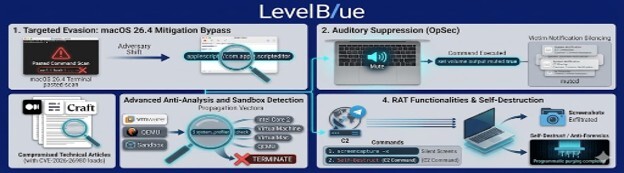
Figure 5. macOS ClickFix internal technical sequence.
Summary
ClickFix campaigns highlight a shift toward human-centric attack strategies, as well as the expanded targeting of macOS, an operating system often left out of campaigns like this. Their effectiveness stems from blending into legitimate workflows and rapidly adapting to defensive measures, making them a significant and evolving threat to macOS environments.


