
Last Friday I was trying out some new code that one of my colleagues wrote to help automate some of the work involved in releasing new versions of the Trust Keeper Scan engine. One of the many things the code did was send emails. I hate writing boilerplate emails, so I was excited to put it to use and save myself some precious time. Unfortunately, when I ran the code for the first time, it crashed with the following error when trying to connect to our Exchange Server:

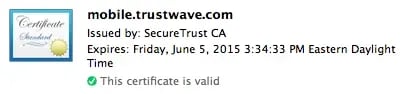
Now, this error is pretty self-explanatory, and having spent time working with other Ruby libraries that utilize OpenSSL, this basically means that we're failing to verify the certificate of the server we're connecting to. The interesting part to me, was that when I visited this URL with Chrome and other web browsers, they successfully verified the certificate provided. Weird huh?
In this blog post, I'll explain some of the diggings around I had to do to get to the bottom of this issue and some other interesting bits I found along the way.
A Gem, Inside a Gem, Inside a Gem, Inside a Gem
First of all, Ruby Gems are pretty cool because you can use them as building blocks to build something bigger, badder, and meaner. One of the tricky aspects of having such a structure like this is tracking down who's responsible for an error when you run into problems.
In our case, we were using the Ruby Viewpoint gem. The Viewpoint gem provides a thin layer on top of Microsoft Exchange Web Service (EWS) and lets you do all kinds of fun things with Exchange, including sending emails. After getting the above error, I was able to track the failure down through the gem dependency chain down to it's source, which turned out to be just a couple gems deep.
- Layer 1: Viewpoint Gem - A light layer for talking Exchange Web Services
- Layer 2: Handsoap Gem - A library for creating SOAP clients in Ruby
- Layer 3: httpclient - A library for HTTP protocol communication
- Layer 4: OpenSSL - A library that interfaces with native OpenSSL
Certificate Verification Nuances in Ruby OpenSSL
So to get right down to it, we're basically trying to establish an SSL-wrapped socket with the target service. We can do this quite easily using Ruby OpenSSL.